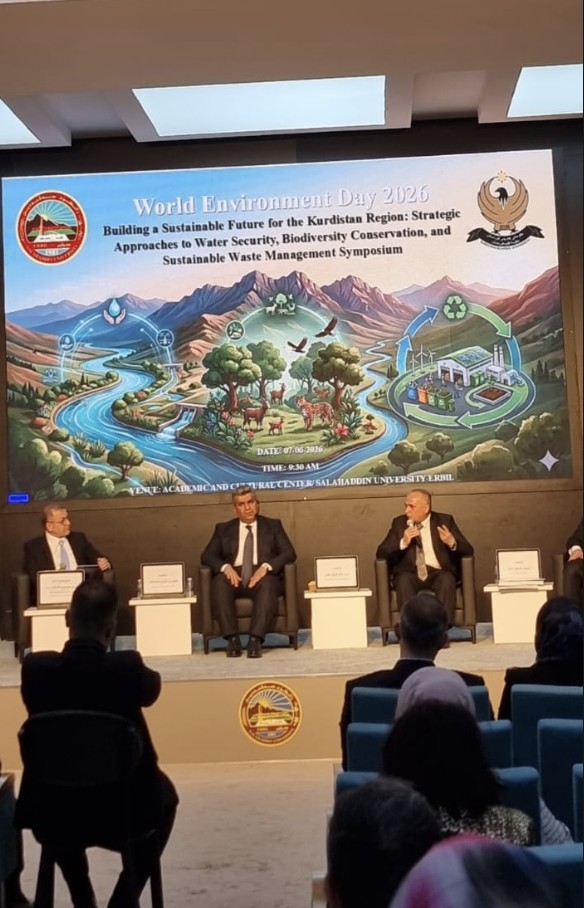
In honor of World Environment Day 2026, observed on Friday, June 5, a symposium was held at Salahaddin University-Erbil on Sunday, highlighting the policies of the Kurdistan Regional Government (KRG) to combat climate change and to protect the environment.
Led by KRG Prime Minister Masrour Barzani, the Ninth Cabinet has focused on protecting the environment, preserving forests, and tackling pollution and climate change. To this end, the Prime Minister’s Office established a Climate Change Unit in late 2023.
“On World Environment Day, we celebrate our actions to protect the environment and become more resilient to climate change,” Wafaa Suleiman Mohammad, speaking on behalf of Senior Advisor to KRG Prime Minister for Climate Change Bayan Sami Abdul Rahman, said in a speech at the event. “The Kurdistan Region is a land of rich biodiversity and a vital water source. Our mountains are water towers for Kurdistan and all of Iraq.
“Rising temperatures, flash floods, and longer droughts threaten our prosperity, placing Iraq fifth globally in terms of climate vulnerability. Under the leadership of His Excellency the Prime Minister, the KRG is turning these challenges into opportunities,” Mohammad said.
“The Runaki Project is securing 24-hour electricity for millions, allowing us to phase out nearly 6,000 polluting diesel generators. This necessary step has reduced air and noise pollution while eliminating 1.1 million tonnes of annual CO2 emissions,” she added.
The KRG has made water security another key priority. “We are shifting from groundwater reliance to surface water and wastewater treatment. Water harvesting projects have been completed, with more underway, to capture rainwater and build resilience against drought. The Erbil emergency water supply project has resolved water problems for many neighborhoods.”
The KRG is also dedicated to bringing its environmental stewardship to the global stage. “Toward this goal, we joined the International Union for Conservation of Nature and the Mountain Partnership. Our native forests and urban greening projects capture carbon dioxide, helping to mitigate against climate change.”
The KRG is also working on establishing legally protected nature areas, from Barzan to Qaradagh, and developing the Erbil Greenbelt, which includes planting 7 million fruit trees in Erbil.
Our commitment to mountain preservation and natural beauty is directly supporting the future of sustainable tourism,” Mohammad continued. “The KRG is taking practical, decisive action to confront climate change. We are investing in a future that is resilient, clean, and prosperous for every citizen. The time for action is now.”
Mohanad Ayub Mustafa, Head of Adaptation and Mitigation at the KRG Directorate of Climate Change, underlined that the Kurdistan Region has been affected by climate change.
”The region used to have vast water resources and green spaces, but now we are facing desertification. We have less snowfall every year; last year saw the lowest amount of snowfall in the mountains, affecting a number of ecosystems. This year was relatively better, but it doesn’t mean that problems won’t occur,” he told Kurdistan Chronicle.
“At the moment, we are facing high frequency, low intensity rainfall, which has led to flash floods. All these factors have pushed us to focus more on climate matters. Finances resources need to be invested here and now, otherwise we might spend twofold to mitigate the consequences later.”
He also underlined that KRG Prime Minister Barzani and the Ninth Cabinet have done more to focus on green investmentment.
“The current administration has done more; take the green belts for example. I’m a member of the Kurdistan negotiation team on climate matters, and in international conferences I mention the green belt projects, which surprises other participants. It’s not without challenges, yet we are beyond phase one, and now working on phase two. Hundreds of trees have been planted, and this serves the local communities and supports eco-tourism. These projects are sustainable, and that’s precisely what we are strategically targeting.”
Huner Khayyat, head of the Environmental Monitoring and Climate Change Unit at the Scientific Research Center of Salahaddin University-Erbil, praised a recent decision by the KRG Ministry of Interior to punish littering, especially as the tourism sector in the Kurdistan Region develops.
“The measure should be seen as an important first step. However, this should not be the final step in addressing environmental protection and enforcement,” he said.
Khayyat underlined that attracting tourists to the Kurdistan Region is “positive because it allows us to showcase the beauty and nature of our country to others, and it also serves as an important source of income for our people and the region.”
However, he warned that “some tourists — or even some local visitors — do not take responsibility for protecting the environment. They leave behind garbage and waste, making natural areas dirty and causing damage to the environment. If this behavior is not controlled, it can seriously harm our natural resources.”
Therefore, he suggested that the KRG apply strict enforcement and fines, as is the norm in European countries. “If these penalties were removed, even some of the most developed countries could face much worse environmental behavior. The same principle should apply here,” he underlined.
Furthermore, Khayyat said that the Ninth Cabinet of the KRG has significantly increased attention to environmental issues.
“Significant improvements have been made in areas such as water management, recycling, waste management, and wastewater treatment. These efforts have had a positive impact on the environment in the Kurdistan Region. Protecting the environment is not only about our generation; it is also about future generations. That is why investing in environmental protection and sustainability is so important.
“As we discussed during the symposium, countries such as Germany and the Netherlands have abundant water resources, yet they still invest heavily in wastewater recycling,” he added.
“The same principle applies to the Kurdistan Region. While it is true that we are experiencing drought conditions and growing water scarcity, environmental protection and efficient resource management should remain long-term priorities regardless of the immediate challenges we face.”
A seasoned reporter and analyst who specializes in Kurdish affairs.