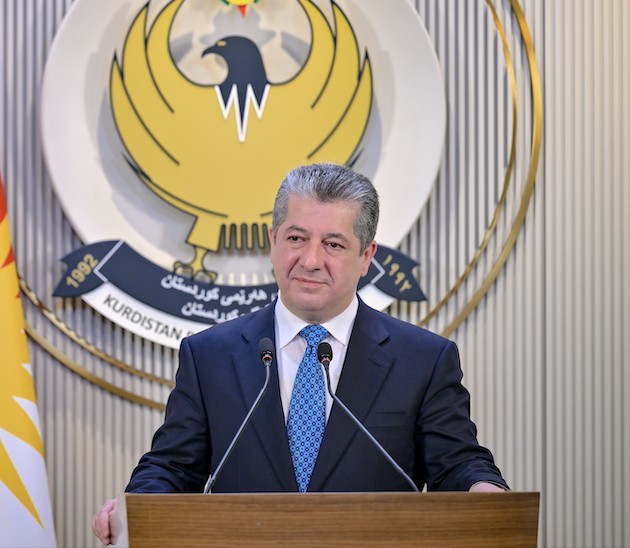
On Monday, Kurdistan Regional Government (KRG) Prime Minister Masrour Barzani said that the Kurdistan Region remains vulnerable to drone and missile attacks due to the lack of adequate air defense systems.
“We’ve had this conversation with all our friends, including the Americans, and we have raised our concerns about the vulnerability of the Kurdistan Region,” KRG Prime Minister Barzani said in response to a question from Kurdistan Chronicle journalist Wladimir van Wilgenburg during a press conference today.
“We don’t have adequate defense systems against incoming drones or missiles. We have asked for adequate protection for all of our peoples and institutions. We are still trying to get those weapons and those systems in place. So far, the U.S.-led Coalition has been providing protection because of their presence.”
In 2024, the Iraqi government and U.S. government agreed that the Coalition will completely withdraw from Iraq by September 2026. While troops have withdrawn from most of Iraq, some remain in the Kurdistan Region.
“But after the departure of these troops, there will be a different situation, and we are trying to speak with both Baghdad and Washington to see what the status will be after the end of the coalition mission here in Iraq at the end of September,” Prime Minister Barzani added.
On November 27, 2025, after attacks on the Khor Mor gas field, Aziz Ahmad, Deputy Chief of Staff to KRG Prime Minister Barzani, said in a post on X that the UK could help by accepting KRG-issued end-user certificates for anti-drone systems.
He said that a British company had delivered an anti-drone system to Khor Mor, but that the system was not working because “the UK government won’t accept KRG-issued end-user certificates, and Baghdad refuses to issue one.”
Prime Minister Barzani confirmed that many oil companies in the Kurdistan Region have already asked for their own defense systems.
“They have been in discussions with both the coalition forces and the Iraqi federal government. I have not heard that there has been resistance, or they haven’t allowed any of the systems to be in place. It is a logistical issue that hopefully will be resolved sometime soon.”
Prime Minister Barzani also underlined that “Kurdistan Region has never sought to be part of these regional conflicts. Yet, unfortunately, it continues to be targeted daily by drone and missile strikes.
“As the Kurdistan Region, we stand firmly in support of a peaceful resolution and an end to these hostilities,” he said.
Prime Minister Barzani said the closure of the Strait of Hormuz has sharply reduced Iraq’s oil exports and federal revenues.
He noted that Iraq previously exported 4 million barrels of oil per day, but that volume has since fallen significantly. “Nevertheless, the responsibility for providing salaries rests solely with the federal government,” he underlined.
Prime Minister Barzani also addressed the electricity issues caused by Dana Gas halting gas production at the Khor Mor gas field on July 16 due to security concerns.
“The suspension of Dana Gas operations at the Khor Mor field has led to a decrease in both gas and electricity production. In the coming days, we will work toward increasing gas output,” he added.
Prime Minister Barzani also expressed support for the Iraqi government led by Iraqi Prime Minister Ali al-Zaidi, including its anti-corruption reforms and attempts to address outstanding issues between Erbil and Baghdad.
A seasoned reporter and analyst who specializes in Kurdish affairs.