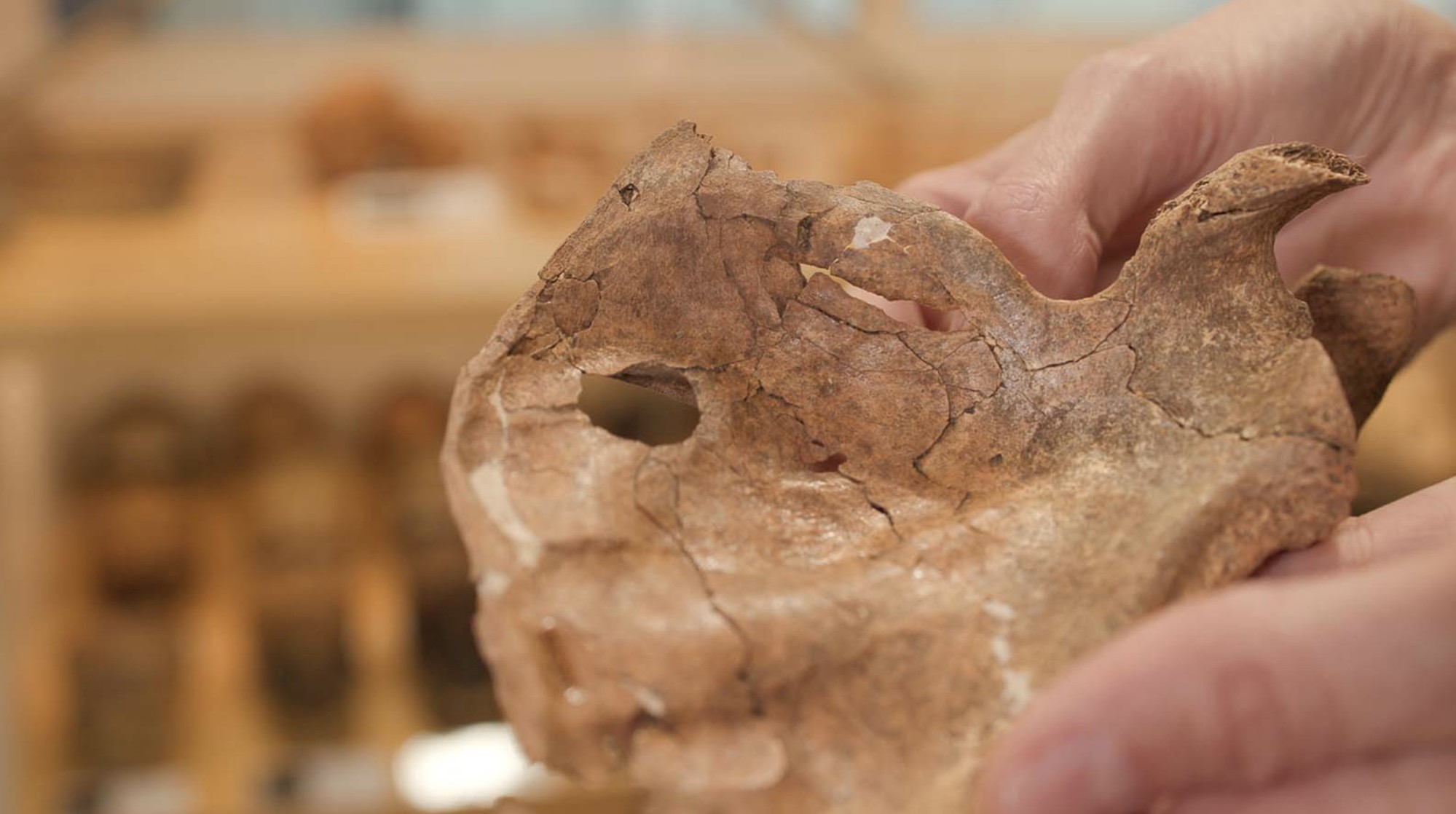
A round hole in the shoulder blade of a Neanderthal whose partial remains were unearthed in the Shanidar cave in Iraqi Kurdistan may be the earliest known example of lethal interpersonal violence with a wooden spear, the University of Cambridge said in a press release on October 15.
The Neanderthal’s shoulder blade was preserved almost intact under seven-and-a-half meters of rock and sediment for around 75,000 years.
Researchers think the fatal strike may have been an intended “heart shot.”
“It’s extraordinary to have a perfectly preserved scapula from 75,000 years ago. These bones are so thin that you often don’t get complete scapulae from modern burials,” said Dr. Emma Pomeroy, study lead author from Cambridge’s Department of Archaeology, in the press release. “We were able to lift it out in one piece from under almost eight meters of rock and sediment.”
The earliest known rounded wooden spear is over 400,000 years old. Just the pointed end survived, pulled from the UK shoreline at Clacton-on-Sea in 1911, the University of Cambridge said.
The vast cave known as Shanidar in the foothills of Iraqi Kurdistan near Barzan is one of the world’s most famous Neanderthal sites.
Excavations in the 1950s led by Ralph Solecki found ten individuals, including a “cluster” of four located in the same spot despite dying at different times, suggesting the Neanderthals had returned to inter their dead.
“Shanidar Cave is not merely a single routine discovery or a passing historical episode; it represents a major milestone and a turning point in the field of global anthropology,” Dr. Abdulwahab Suleiman, Director of Antiquities and Heritage in Soran, told Kurdistan Chronicle.
“Ever since Ralph Solecki initiated the first archaeological excavations at Shanidar in 1951, dozens of exceptional and unprecedented discoveries have come to light. These findings fundamentally transformed the world’s understanding of Neanderthal behavior, social life, and consciousness, rightfully establishing Shanidar as the ultimate focal point and Mecca of Neanderthal cave sites worldwide.”
Read More: Shanidar Cave: Unveiling the Ancient Mysteries of Kurdistan
Later, when excavations resumed in 2013 in partnership with the University of Cambridge, state-of-the-art technologies and advanced interdisciplinary scientific techniques were deployed, he added.
“This not only re-confirmed Solecki’s original findings, but also unveiled even deeper, more extraordinary insights into early human history.”
He said the significance of these discoveries for the Kurdistan Region operates on multiple crucial levels, including scientific recognition, diplomatic relations, and tourism.
“History proves that scientific truth cannot be concealed. Despite persistent efforts by central authorities and neighboring states to ignore or erase the names of ‘Kurdistan’ and the ‘Zagros Mountains’ from international academic reports and literature, Shanidar firmly embedded the name of Kurdistan into the heart of global academia, proving that this land was a true cradle of civilization,” he stated.
Read More: New Netflix Documentary Puts Shanidar Cave on the Map
In May 2024, a Netflix documentary produced by the BBC focused on the Shanidar cave and excavations undertaken by archaeologists from the University of Cambridge and Liverpool John Moores University.
Read More: Could Erbil Become the Tourism Capital of the Middle East?
Dr. Suleiman told Kurdistan Chronicle that this rich archaeological legacy forms the backbone for developing sustainable archaeological and scientific tourism in the Soran Independent Administration and the broader Kurdistan Region, serving as a powerful magnet for international researchers, academics, and tourists in the years to come.
Furthermore, he added that the discoveries at Shanidar have forged cultural and scientific bridges between the Kurdistan Region and leading global institutions, such as the University of Cambridge. “This significantly elevates Kurdistan’s international standing and soft power diplomacy on the global stage,” he said.
“As the Directorate of Antiquities and Heritage in Soran, we proudly stand as custodians of this world heritage, ensuring that the names of Kurdistan and the Zagros Mountains will never be sidelined on the scientific map of the world,” Dr. Suleiman concluded.
A seasoned reporter and analyst who specializes in Kurdish affairs.