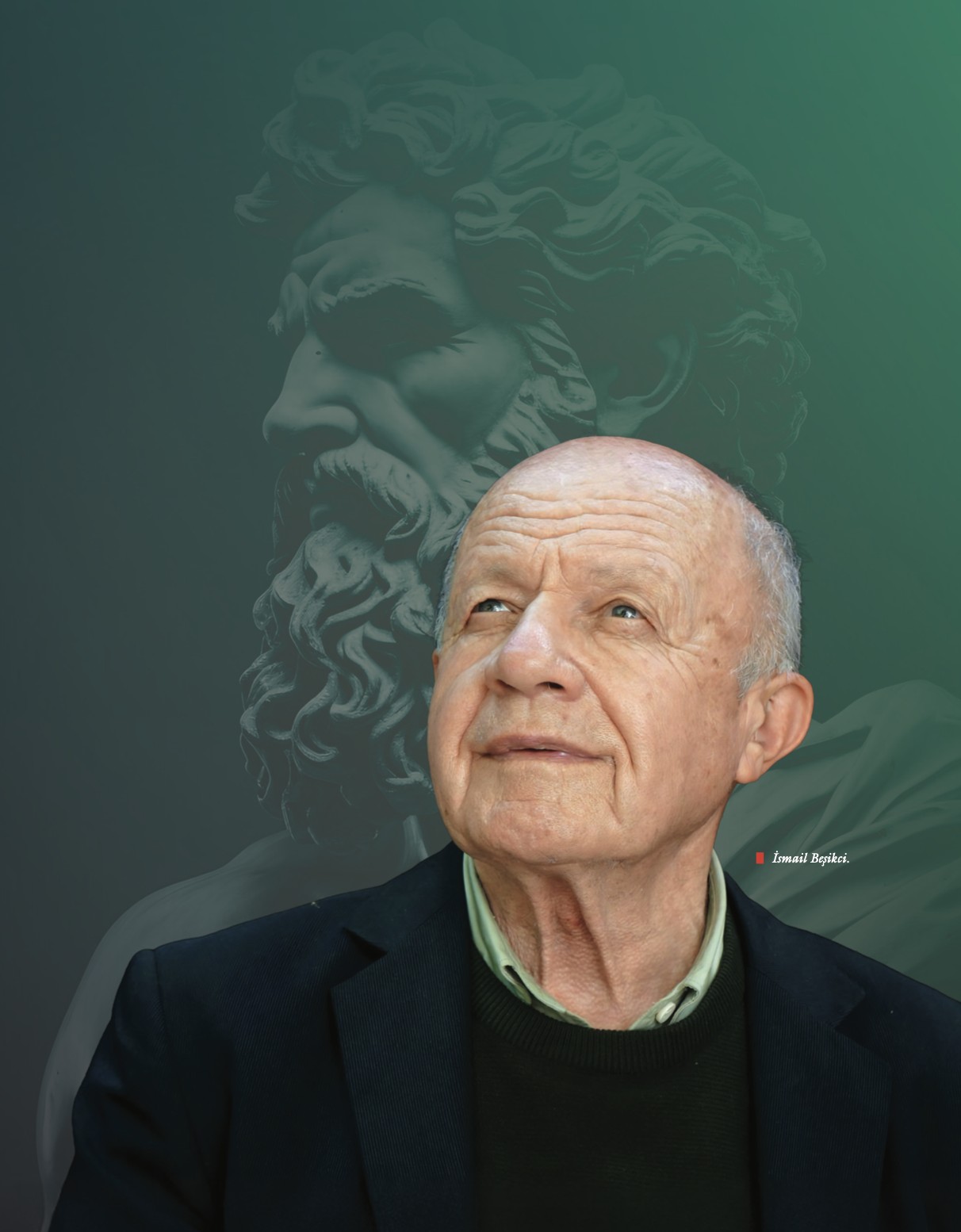
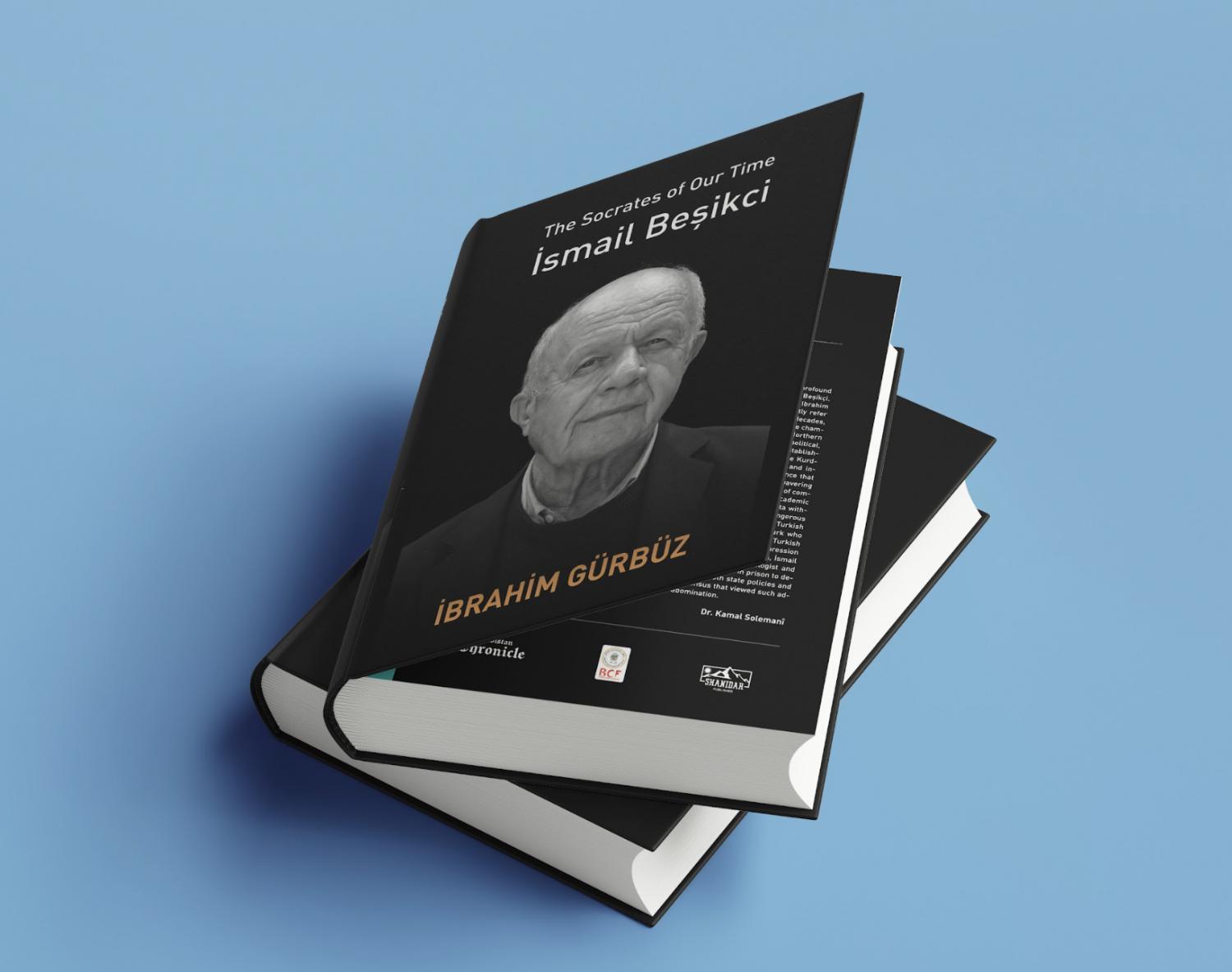
The Socrates of Our Time: Ismail Beskci, by Ibrahim Gurbuz, which has just been published by Shanidar Publishing House, is an astonishing testament to the life’s work of one man to research and publicize the history of the Kurds as a nation divided among four states, and to campaign for their right to self-determination. What is most remarkable is that he is an ethnic Turk and a citizen of Turkey, who grew up having no awareness that such people as Kurds existed. Yet, encountering Kurds in southeastern Turkey as a young man, he devoted himself to countering the official denial of their existence and campaigning for their rights, despite the risk to his own life and liberty.
Ismail Besikci was born in 1939 to a middle-class family in Iskilip, the youngest of four children. After he finished primary school, his father wanted him to learn a trade, like his older brothers, but his dream was to study. With support from other relatives, he continued his education and gained a scholarship to the Faculty of Political Sciences at Ankara University in 1958. Here, he became interested in sociology as well as the disparities between different parts of Turkey.
Discovering the Kurds
For his internship as a trainee administrator in 1961 he was sent to Keban, a town in Elazig Province, where he discovered that the local villagers did not speak Turkish and an interpreter was required to talk to them. He was so struck by the fact of a local non-Turkish population, the Kurds, whose existence he had never known about, that he later returned to make a sociological study of them for his doctoral thesis, which was published in 1969 as Change and Structural Problems in the East (Nomadic Alikan Tribe).
In the meantime, however, he had already fallen foul of the authorities. Employed as an assistant at Ataturk University from 1964, he had taught his students about the existence of the Kurds as a separate people in Eastern Anatolia and was dismissed in 1968 on the grounds of having committed a criminal offence.
It is from this point that his similarity to Socrates becomes apparent. Just as Socrates was devoted to the search for truth through the use of reason, and was arrested, charged, and eventually condemned to death for “corrupting the youth” with his enquiries, Besikci likewise was dedicated to scientific enquiry and absolute adherence to the facts, no matter the consequences. Over the next 50 years, he was relentless in exposing the official narrative that Turkey is an ethnically homogenous state as a complete fiction. Time and again, his books and articles landed him in jail, but he would not be silenced.
Life of research and writing
One thing that stands out from the account of his battle with the Turkish authorities is his fearlessness. On his first arrest in 1971, university colleagues were enlisted to make clear to him that if he renounced his stand on the Kurdish issue, he would get off lightly. “I did not take this suggestion seriously,” he writes in his memoirs, and goes on to describe being beaten so badly in detention that he could only crawl, not stand, yet his main concern was not to lose his books and research notes, and be able to continue working.
Besikci’s time serving various prison sentences was fruitful both for himself and for his fellow detainees. He was able to spend time with many detained Kurdish activists and learn more about their history of struggle against oppression. As well, he was a source of inspiration, constantly encouraging them to stand firm, maintain their separate identity, language, and right to self-determination as a nation. His research expanded to investigate the situation of the Kurds as a people whose nationhood has been denied ever since the end of World War I and the fall of the Ottoman Empire, when their territory was divided between the states of Turkey, Syria, Iraq, and Iran, whose boundaries were fixed by the Treaty of Lausanne in 1923.
Moving beyond the situation of the Kurds within Turkey to consider Kurdistan as a whole as a fragmented nation, Besikci makes the comparison with colonized peoples such as those in the French possessions of the West Indies and North Africa. The book explores the psychology of the colonized, as laid bare by Frantz Fanon in Black Skin, White Masks. Besikci argues against those who settle for a struggle for the rights of Kurds within Turkey as an ethnic minority, as this would be acceptance of an inferior status. He insists that nothing less than the establishment of an independent Kurdistan will suffice. Having studied the history of the political struggle in different parts of divided Kurdistan, he developed the concept of High Kurdish Consciousness, whereby Kurds should put the interests of the entire Kurdish nation first rather than descending into factional strife.
Having given his life to research and writing on the Kurdish issue and spent so many years in jail, Besikci could not have produced his corpus of literature without the support of courageous publishers and financial backers. A leading figure among his supporters is Ibrahim Gurbuz, the author of The Socrates of Our Time, who learned of Besikci’s writings as a young man in the 1980s and later set out to establish institutions for the study of Kurdish language, history, culture, and arts.
This culminated in the establishment of the Ismail Besikci Foundation in Istanbul, which houses his archive as a resource for researchers; the Weqfa Ismail Besikci in Erbil; and the Besikci Center for Humanity Studies at the University of Duhok. It is an amazing achievement inspired by the courage and dedication of one man.
Margaret Okole is an editor of academic books and journal articles who has worked with many authors in the areas of Middle Eastern Studies, nomadic pastoralism, forced migration, and multiculturalism.