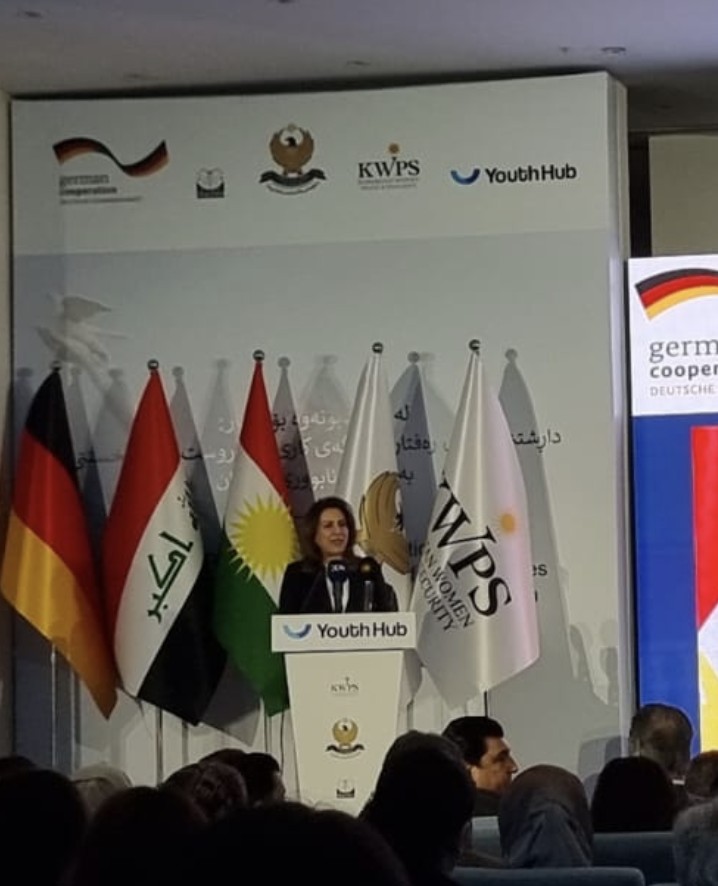
The increased participation of women in the economy is essential to boosting economic growth in the Kurdistan Region, government officials, international partners, and women’s rights advocates said during an event on Monday at the Kurdistan Youth Hub in Erbil focused on creating safer and more inclusive workplaces.
The event was organized by the Kurdistan Regional Government (KRG) High Council for Women and Development, together with the “Strengthening Participation, Peaceful Coexistence and Equality in Iraq ” program, which is funded by the German government and supported by the German development agency GIZ.
Rawand Hussein Ali, managing director of the Kurdistan Youth Hub, said the goal should be to move beyond discussing challenges and instead build partnerships that lead to practical action.
“The Youth Hub is not only an event venue. It is a platform connecting people and bringing them together to lead positive change,” he said, emphasizing the importance of connecting government institutions, international organizations, and other partners.
Dr. Mohammed Shukri, head of the KRG Board of Investment, said the government is encouraging women to participate in investment projects and is working to facilitate their involvement in the economy.
He pointed to the support of KRG Prime Minister Masrour Barzani for greater economic participation by women and women-led projects.
“Women’s economic participation means higher economic growth,” Dr. Shukri said, adding that the Board of Investment sees itself as a bridge between the government and private sector and is ready to provide support for women entrepreneurs.
“Women’s participation is not only about numbers, but also the quality of work and access to important positions,” added Sarwar Kamal Hawari, Deputy Minister at the KRG Ministry of Trade, Industry, and Commerce. “The participation of women will also encourage more investment and innovation.”
Kerstin Spriesterbach, Germany’s Consul for Economic Cooperation and Development, said equal rights on paper were essential but not sufficient to ensure women could fully participate in economic life.
“Women must have the same opportunities in the labor market,” she said, arguing that greater female participation would bring more skills, businesses, and economic growth to the region.
She warned that when qualified women are prevented from entering the labor market because of discrimination, society loses talent and the economy loses out on potential growth. “Many women know equality is not something simply handed to us. Women and men must challenge established practices.”
Spriesterbach also stressed that women’s economic participation should not be viewed solely as a women’s issue, but as an economic issue affecting the entire Kurdistan Region.
She said the code of conduct proposed at the event could provide practical guidance for workplaces by establishing expectations, responsibilities, and boundaries for both employees and management, but that businesses, government institutions, and other actors would all need to play a role.
Dr. Axel Klaphake, Country Director GIZ Iraq, underlined that women should be able to lead, make decisions, and take responsibility, but that this could only happen when they feel safe and valued in the workplace.
“We cannot talk about inclusive economic development without talking about women’s equal participation,” Dr. Laphake said, adding that developing a workplace code of conduct is an important step.
Dr. Khanzad Ahmad, Secretary-General of the KRG’s High Council of Women’s Affairs, said the development of a safer working environment is not the responsibility of a single institution.
“It requires local and international partnership and cooperation,” she said, stressing that all relevant institutions and stakeholders should contribute to developing the proposed code of conduct.
“No economy has developed when half of its population has been ignored,” she added.
Dr. Khanzad called on the private sector, civil society organizations, and government institutions to take part in the process and ensure that the experiences and views of women themselves are reflected in the final framework.
A seasoned reporter and analyst who specializes in Kurdish affairs.